skip to main | skip to sidebar
GLCtest
  • HOME
    • ABOUT US
    • GLC ANTHOLOGIES
  • LINKS
    • RECOMMENDED SITES
    • DISCLAIMER
  • GLC Global Board
  • AUTHORS
  • CONTACT
  • GLU
  • ICDD
  • Follow Us on Twitter

    21 February 2011

    Time for a new Paradigm


    Sharan Burrow
    These are truly times for anger.
    The world is barely re-emerging from the deepest economic crisis in a century, yet the very policies and mindset that caused the problem in the first place are back with a vengeance. Indeed, the world economy risks sliding back into crisis as dangerously short-sighted policies are put into place. The brave words of reform from world leaders in the G20 meetings of 2009 are now largely forgotten and have been replaced with the old scriptures of fiscal consolidation and calls to address the “fundamentals”.
    And thus the world is fast slipping into a self-defeating round of “competitive austerity” where everyone seeks salvation from austerity at home through export-led growth. This is a strategy that might have worked for some for a time, but those days are gone: credit-driven consumption in a few key countries can no longer make up for the lack of wage-driven consumption worldwide.
    Weakness in wage growth has been shown to be a prime cause of the crisis. This should come as no surprise: with globalization there has been a growing disconnection between wage growth and productivity. Whereas worker compensation rose in parallel with the improvement of productivity until the early 1980s, overly restrictive monetary policies, trade liberalization, labour market deregulation and employers’ strategies have combined since then to weaken this link. The consequences are now well documented: the share of labour income has dropped in most countries, inequalities have increased almost everywhere, and consumption has been maintained in large part through credit.
    What is worse is that since the 1990s the decline in labour’s share of income has been highly pronounced in countries with trade surpluses (see Figure 1). In other words, the winners of the new global trading system have not shared those gains with their workforce… This is profitable for some individual companies, but it is bad for overall growth and prosperity. Ultimately it is unsustainable.
    Figure 1: Change in wage share, 1995-2005
    Source: World of Work Report 2010, ILO.
    With unemployment and household debt still high in some of the key jurisdictions in the world (including both the U.S. and Europe) and with governments engaging in counter-productive austerity, it is more urgent than ever to ensure that workers get their fair share. More than a moral issue, it is also the only way to extricate ourselves from the current macroeconomic mess.
    We need a fundamental change in paradigm. First, jobs and decent work can no longer be some collateral by-product of economic policies geared to rolling out the red carpet to “investors”. Full employment has to become anew the central objective of economic policy, and it should be expected that governments use all their levers – fiscal, monetary, regulatory and industrial – to achieve it. In parallel, we need active policies to improve workers’ capacity to engage in collective bargaining to link wages to productivity growth once again.
    All of this will require new “rules of the game” internationally. As it stands, the current international economic and financial system has given the upper hand to speculators and tax evaders, fostered instability and put the burden of economic adjustment on the parties that were already experiencing difficult times. As a result, the fate of entire societies has not improved much over the past thirty years. This needs to change.
    First, we need to reform the currency system to ensure that adjustment is not achieved mostly by deflating deficit countries, but through “reflating” surplus nations. In this way, the system would ensure that the adjustment led to more growth for all, not further wage and price depression. This idea is not new; it was first proposed by J.M. Keynes back in 1944 and has elicited renewed interest recently. Such a system would perhaps entail capital controls of some kind, but that would remain a lesser evil than the costs of disorder.
    Second, we need new regulations on tax havens as well as on taxes on income and wealth. Controlling tax evasion and tax competition has to become a policy priority. At a time when the average working person is being asked to shoulder the bailout costs of the financial system, the least that can be asked is that all pay their fair share. Eliminating these loopholes is not nearly as complicated as some make it sound and would bring much needed resources into the fiscal purse. In the same spirit, the establishment of an international financial transactions tax to raise new resources would go a long way to make it possible for financially strapped governments to fund the necessary increase in Official Development Assistance to achieve the Millennium Development Goals (MDG) as well as the mitigation costs of climate change. It has been estimated that, for the United States alone, such a tax would conservatively raise in the neighbourhood of $US170 billion, the equivalent of the entire funding of the MDG programme…
    Last but not least, we need a renewed focus around the enhancement and respect of labour standards by all. When it comes to labour rights, the world faces a classic “free rider” problem. Now more than ever, it is essential to ensure a basic international social floor, that all countries endeavour to respect basic standards and that competitive advantage does not come at the expense of the “over-exploitation” of workers. If it is true that “labour is not a commodity”, the manner in which we achieve economic prosperity is as important as the goal itself.
    None of these ideas is particularly radical. What sets them apart from the current orthodoxy is that they give prominence to workers’ needs and aspirations, and pragmatically define a “high” road to economic development.
    The experience of the last three years shows that departures from economic orthodoxy are feasible at times when the “establishment” is going through near-death experiences, but that this does not have a lasting effect. In hindsight, the brief flirt with Keynesianism when the financial system was on the brink of collapse only lasted as long as it was needed to save the banks.
    If during the crisis workers’ organisations could have anticipated that a new era of dialogue had begun, the moment has clearly passed. Our social “partners” have left the restaurant and presented us with the bill: austerity, tax increases, wage concessions, increased precariousness, public sector retrenchment, cuts in public pensions, and so on.
    If much of the solution to our problem is international, trade unionists will have to find ways to exert their power and influence internationally as we confront the consequences of the crisis.
    Both opinion polls and the wave of strikes and protests in many countries show the growing discontent with one-sided and short-sighted policy solutions.
    In times of anger, the moment is certainly not for business as usual…

    Download this article as pdf

    Sharan Burrow is General Secretary of the International Trade Union Confederation (ITUC).

    14 February 2011

    Europe’s Hidden Inequality

    Michael Dauderstädt
    The European Union (EU), in its founding treaties, set itself the aim of economic, social and territorial cohesion. This aim is generally interpreted to mean that the EU will strive to reduce income inequality within its area of integration. Reducing inequality is, as recent studies continue to show, an important and just goal since inequality blights the lives and prospects of those affected.
    Unequal Income Distribution in Europe
    As a result of a number of enlargement rounds since 1972 the EU consists of member states at widely varying stages of development and divergent income levels: besides small, rich countries, such as Luxembourg (annual per capita income: around 60,000 euros), there are also large, poor countries, such as Romania (annual per capita income: around 2,900 euros). A comparison of Europe’s regions reveals even more egregious differences between the richest region (Luxembourg) and the poorest: annual per capita income in the poorest regions of Bulgaria and Romania is even lower than the national average.
    With a few exceptions, functional income distribution between wages and profits has long been deteriorating in the EU. The wage share has fallen, for example, in the countries of the Eurozone, from 68% in the 1970s to 57% in 2006. This deterioration in functional distribution, as well as more marked wage dispersion, also partly explains the deterioration in personal income distribution in most member states. Official Eurostat data confirm this trend showing increasing intra-country inequality, which is estimated through the S80/S20 ratio, i.e. the total income of the richest 20% divided by that of the poorest 20% of the respective population (a value of 4 meaning that the former earn four times more than the latter). By calculating the inequality within the EU as a whole as a weighted average of these intra-country values they give it a value of about 4.9, which has been rising over the past decade.
    As far as the EU27 (the present EU with 27 member states) and the EU25 (minus Bulgaria and Romania) are concerned, the Eurostat figures – ranging between 4.5 and 5 – underestimate real inequality considerably. This is mainly because they present the (weighted) averages of the member states. These averages, however, abstract from the enormous differences in per capita income between the countries. Eurostat has not compared the incomes of what is really the richest quintile in the EU with those of the poorest, but erroneously assumes that the richest (or poorest) quintile is the sum of the richest (or poorest) quintiles of all member states.
    In fact, the richest quintile consists predominantly of households in the richer member states, and includes even the second and third richest quintiles in those states, whose average income is still higher than that of the richest quintile in the poorer member states. The poorest EU quintile consists of the richer quintiles of the poorer member states (in Bulgaria and Romania, for example, from all quintiles). To ensure precision the 100 million (that is, about the size of one EU27 quintile) richest (or poorest) individuals in the EU would have to be identified and aggregated.
    Realistic Estimate of Income Distribution: The EU Is More Unequal than India
    If one makes the effort to construct realistic EU quintiles on the basis of the available EU data, an entirely different picture of the relationship between the richest and the poorest EU quintiles emerges (cf. Table 1). The first such estimate for 2004, based on World Bank data, yielded relatively low values(1); however, a methodologically more precise estimate(2) using EU data yields somewhat higher values. It makes a big difference whether incomes in the various member states are compared in terms of purchasing power or exchange rates. Since purchasing power in the poorer countries is higher (primarily because of lower rents and services), the differences are correspondingly lower.
    Table 1: Income Distribution in the EU25 and EU27 by international comparison (total income of the richest 20% divided by that of the poorest 20% of the respective population.
    * PPS: Purchasing Power Standard
    Source: For the EU 2004: World Bank, Eurostat and author’s own calculations (Dauderstädt 2008); for the EU 2005–2008 Eurostat and author’s own calculations (Dauderstädt and Keltek); non-EU: World Bank.
    Table 1 presents comparative figures based on World Bank data for China, India, Russia and the USA. World Bank data may be based on other measurement methods, but a comparison seems justified to the extent that the Bank’s data on inequality in individual EU member states comes very close to those of the EU. If one measures EU inequality in euros it comes out significantly higher for the EU27 than for all four large countries of comparison. The picture is rosier for the EU25, coming out at around the same level. Measured in purchasing power terms things look rosier still. However, as inequality within countries is measured in the respective national currency without taking into account regional purchasing power, a comparison with euro figures seems obvious.
    The new estimates also make possible a more realistic view of the dynamics of inequality. While the official EU statistics report rising inequality, actual inequality between 2005 and 2008 was on a downward trend. This was due to the fall in inequality between countries which more than compensated for the increased inequality within EU states. It remains to be seen whether this trend will survive the recent crisis, which has severely reined in or even put into reverse the catch-up processes of some poorer member states. The final outcome will depend on how much growth has fallen in the richer countries in comparison.
    From Inequality to Social Cohesion
    The high inequality between states is increasing – mediated by the integration of the markets for goods, services, capital and labour in the EU – inequality within states. This effect was to be expected in the richer member states since wages there have come under pressure due to cheap imports, immigration and relocation of production. The same mechanisms should have improved distribution in the poorer countries. However, to the extent that it was visible at all, this effect could be observed only very late in the wake of strong – and apparently not sustainable, unfortunately – periods of growth from 2004.
    The reduction of inequality, therefore, requires a dual approach in the form of measures to reduce inequality between and within member states. Domestically, wages should rise with productivity (plus the target inflation rate) in order to give workers a decent share in economic growth, which would also ensure more stable domestic demand and impede harmful competitive devaluations in real terms. Besides primary distribution, however, state redistribution also affects the extent of inequality. Transfers which substitute market incomes where they are lacking (for example pensions, social security, unemployment benefit, sick benefit) should increase in step with average per capita income.
    The EU should monitor wage policy and issue clear warnings with regard to divergence in either direction (unrealistic wage increases or severe wage restraint). There should be a minimum wage policy to underpin this goal and to prevent a race to the bottom by paying immigrants and service providers at the wage level of the relevant host country. These problems will be assuaged to the extent that income and wage levels rise in the countries of origin. The reduction of inequality between states, therefore, makes a twofold contribution to social cohesion in Europe. As already mentioned, this has also been responsible for the progress made in recent years. However, if these catch-up and convergence processes were to slow down or even go into reverse, these successes would be put in jeopardy. Against the background of the crisis, therefore, the following policies are appropriate:
    • Investment in poorer member states should be less dependent on the herd instinct of the capital markets and be funded to a greater extent through public financing channels, such as the European structural funds or the European Investment Bank. To that end, the EU’s own resources should be increased, with the raising of European taxes. Stricter regulation of the financial markets should avert the emergence of debt-driven bubbles.
    • Admission to the Monetary Union or the adoption of the euro should no longer depend on attaining narrow inflationary and exchange rate goals since this forces countries to restrain appreciation of the national currency in real terms, which is a key element in catch-up processes.
    • Enlargement policy should demand of candidate countries, besides the fulfilment of the Copenhagen criteria, a minimum level with regard to income and income distribution, since the accession of poor and unequal countries hinders and even jeopardises social cohesion in the EU.
    Finally, the EU should make available better and clearer statistical information on inequality in Europe. Eurostat should regularly publish data not only on relations between quintiles, but also on average per capita incomes for all quintiles in all member states, if possible going back to 1995 in order to make possible a realistic assessment of the evolution of income distribution.

    (1) M. Dauderstädt (2007), Ungleichheit und sozialer Ausgleich in der erweiterten Europäischen Union, Wirtschaftsdienst, Vol. 88, 4, April, 261–269.
    (2) Dauderstädt and Keltek (2011) ‘Immeasurable Inequality in the European Union’ Intereconomics Vol. 46/1 pp.44-51.

    Download this article as pdf

    Michael Dauderstädt is the director of the division for Economic and Social Policy at the Friedrich-Ebert-Stiftung.

    Further reading:
    Michael Dauderstädt and Cem Keltek (2011) Immeasurable Inequality in the European Union, Intereconomics Vol. 46/1 pp.44-51. Available online at: http://www.intereconomics.eu/

    7 February 2011

    Domestic Workers in Switzerland protected by the Country’s first Sectoral Employment Contract


    Mauro Moretto


    Vania Alleva

    In Switzerland as elsewhere, the State has been retreating on social policy in recent years. This is leading to a decline in social service provision and, consequently, to an increase in demand for domestically based services. Nobody knows exactly how many waged employees are currently at work in Swiss private households (as many are unreported), but statistical estimates suggest that their numbers are continually increasing. At the end of 2007, the Unia trade union, on the basis of various studies(1), put the number of full-time jobs in the sector at about 125,000 (approx. 4 per cent of the total workforce). More than 90 per cent of these employees are women. Many are migrants, often without any legal residency status. They come from a whole range of countries where they had often previously gained academic qualifications and worked in other occupations. Recently, increasing numbers of women from the new EU member states have been finding jobs in Swiss private households.
    Fighting low wages and poor working conditions
    Despite the legal risks, and other incentives to stay hidden, more and more private household workers are venturing out to see Unia. They report appalling working conditions: extremely low wages, combined with hefty deductions for board and lodging, often no social security or pension coverage, massive daily workloads, pay stoppages if they fall ill or if the employer goes on vacation, uncompensated work on public holidays, obviously no overtime arrangements, and so on. No wonder that all the available studies pinpoint this sector as the one with the highest proportion of precarious employment relationships and working poor.
    For more than ten years now Unia has, together with other unions in the Swiss Federation of Trade Unions (SGB/USS), been fighting against the social scandal of the working poor and for substantial pay rises in low-wage sectors. At the turn of the 21st century, it chalked up some important successes in sectors such as hospitality and retailing. However, as Switzerland still does not have a general legal minimum wage, this struggle runs up against certain limits – especially where there is no organized negotiating partner on the employer side with whom to agree on binding minimum wages. As that applies particularly to domestic workers, Unia and the SGB/USS called on the Swiss government, at the end of 2007, to make use of the legal possibilities that were created as part of the accompanying measures for the free movement of persons between Switzerland and the European Union, and to decree for this category of workers the first-ever Switzerland-wide “standard work contract” (Normalarbeitsvertrag or NAV) with binding minimum wages and working conditions. An NAV is not a collective agreement, but a sector-specific legal minimum wage for sectors in which there are no collectively agreed provisions.
    At the same time, Unia drew public attention to the highly precarious working conditions experienced by domestic employees. The government finally took up the union concerns and asked an experts group to work out the parameters for an NAV with binding minimum wages. Taking part in that group were representatives of the cantonal and national authorities, employer organizations, and organizations in related sectors (cleaning and hospitality), as well as the authors of the present article, who were representing the unions. The experts group reported back in mid-2009 with a proposed NAV that took account of multiple elements and requirements. The main focus was on the setting of minimum wages that would reflect the wide-ranging and physically demanding tasks involved in private domestic work. Concretely, the experts’ group defined three wage categories on the basis of experience and training: 1. untrained employees, 2. experienced employees and 3. employees with vocational training or long experience. For the domestic employees’ protection and security, other elements going beyond the legal requirements are vital. Among them are working time arrangements (including overtime), holidays and leave, and the continued payment of wages in case of illness. Although the Unia representatives pressed for these elements to be included in the proposed NAV, they were left out – both because they are covered by existing cantonal NAVs and because the legislation underpinning national NAVs does not provide for them.
    A first step in the right direction
    On its way through the political and administrative procedures, the draft NAV had to overcome some resistance and many hurdles. Some cuts also had to be accepted, notably to the effective minimum wage levels, before the national government decreed the first NAV for domestic employees, with binding minimum wages and the force of law, in October 2010 (see here the full text of the law in German, French and Italian) . To date, this is the only national-level NAV, so its significance goes beyond the sector for which it was adopted.
    The NAV came into force on 1 January 2011, and it is an important step in the right direction. The compulsory minimum wages are:
    • CHF 18.20 per hour for untrained workers

    • CHF 20.00 per hour for untrained workers with 4 years of professional experience or for workers with two years’ training

    • CHF 22.00 per hour for workers with three years’ training.

    That is less than the experts group proposed, but it is nonetheless a significant improvement on the current situation and it sends out an important signal to domestic workers employed in Switzerland. The minimum wage for untrained domestic employees corresponds to about 55 per cent of the average gross wage. The mandate given to the group had specified that the minimum wages set for domestic employees were under no circumstances to exceed the minimum wages negotiated by the social partners for the related cleaning and hospitality sectors. But by pointing to the many different tasks performed by domestic workers, who for example often help to care for children and elderly people, the experts were able to justify a partial waiver of this requirement. For these minimum hourly wages to apply, a domestic employee must work on average at least 5 hours a week for the same employer. The main reason for this is that home helps who clean several households on a purely hourly basis in fact earn considerably more (as a rule, CHF 25.00 or more) and are therefore scarcely affected by wage dumping.
    The Swiss delegation will now be in a good position, at the International Labour Conference in June 2011, to push hard for the adoption of the new Convention that will enshrine fair employment conditions for domestic workers worldwide.
    Implementation: an uphill task
    Now for the difficult, challenging part - implementation. Ever since 1 July 2004, the canton of Geneva has had its own domestic workers’ NAV with minimum wages – a precursor to the national NAV. So far, experiences with it have been very positive. Admittedly, it is difficult to monitor whether the NAV is being correctly applied, as we often do not know in which households domestic employees are working. But word has increasingly got around among these workers that the NAV gives them certain rights. And when necessary, they do go to the labour courts to get those rights upheld. The highest-profile case was won by Unia Geneva, which secured back payments of CHF 70,000 for a married couple who were both working as domestic employees. The NAV does provide protection, and it enables employees to defend their rights more effectively. The experience in Geneva shows that employers want to avoid the courts and will often, in case of dispute, pay up the minimum wage without further ado. Employers are also better informed about their duties.
    In the case of the national NAV on domestic work, verification is seriously hampered by the opaque and fragmented nature of this part of the labour market. Monitoring of compliance with the NAV is first and foremost the task of the tripartite commissions in the cantons. Thanks to the binding minimum wage rates embodied in the NAV, these commissions have been provided with the instrument they need in order to ensure and enforce, at the very least, effective protection against wage dumping. To get the new NAV applied, the tripartite monitoring bodies will need to be supported with various instruments, including broad information campaigns aimed at both employers and employees.
    Still to be tackled is the question of the residency status of domestic employees from non-EU countries. Although the degree of exploitation certainly does not depend on residency status alone, the demand for the regularization of undocumented immigrants remains crucial. Only through such legal security can lasting improvements be achieved in the living and working conditions of these employees and their families. Beyond regularization, it is absolutely crucial to de-couple access to courts from the residency status of migrants; this will go a long way in reducing their precariousness.
    Information and targeted union organizing
    There are also challenges for Unia and other organizations engaged in this field. As domestic employees cannot be informed and organized at their workplaces, alternative locations have to be sought or created. Essential to this is the closer networking of trade unions, migrants’ associations with strong representation of women, and organizations working in the migration field. Here, Unia in particular can build on its long years of cooperation with the many associations through which migrants maintain links with their countries of origin. The union’s experience as an intercultural mediator must be adapted to the domestic workers’ situation. Conscious efforts must be made to recruit and train contact persons and reps who know the specific living and working circumstances of domestic employees and speak their language. Equally, social and political alliances are needed in order to offset the limited scope for self-organization. This entails organising targeted information meetings, language courses, or integration courses, which promote empowerment, exchanges of experience and collective processes.
    (1) Including Alleva, V. and Niklaus, P-A (2004) Leben und Arbeiten im Schatten. Studie der Anlaufstelle für Sans-Papiers und GBI, Basel: ECOPLAN.

    Download this article as pdf

    Vania Alleva is a member of the executive committee and leader of the service sector branch of Unia, the Swiss inter-professional trade union.
    Mauro Moretto is a member of the leadership of Unia's service sector branch.

    24 January 2011

    International Labour Standards: an old Instrument revisited


    Frank Hoffer
    During the last decades, labour markets in many countries have been deregulated and trade union strength has declined. Trade liberalization and deregulated financial, product and labour markets created a mutually reinforcing trend towards weaker regulatory provisions. Lower labour market protection and increased precarious employment resulted in a declining wage share and growing inequality. The lack of wage-based aggregate demand that followed from these dysfunctional developments translated into massive export surpluses in some countries and debt-financed consumption in others. The crisis has proved that both trends were unsustainable.
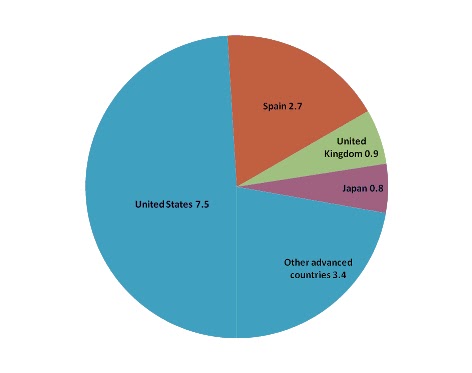
    The crisis has shown not only that “employer-friendly” labour market regimes are not employment-friendly, but also that they are dangerously pro-cyclical. In the US and Spain, two countries characterized respectively by underdeveloped labour market protection and massive precarious employment, the economic downturn rapidly translated into massive employment and wage losses. These two countries actually account for two-thirds of all crisis-related job losses in the advanced countries.
    Change in number of  unemployed people in advanced countries: 15.3 million  
    Source: IMF-ILO, 2010, Oslo
    Labour legislation has the double function of protecting workers against hazardous working conditions and abuse of market power as well as acting as an automatic stabilizer against the volatility and over-shooting of under-regulated labour markets. However, in recent decades there has been a regulatory race to the bottom. Deregulatory ‘successes’ in one country created parallel pressures to emulate it in neighbouring countries. True, not all countries deregulated to the same extent and some countries continued to pursue a high protection/high productivity path, but no country remained unaffected by the general tendency towards lower levels of protection. While a few individual countries managed to maintain and sometimes extend protective regulation under the current globalization regime, all felt the pressure to reduce labour costs by weakening employee rights and protection. This demonstrates the need for coordinated action to reverse the overall trend.
    During the three decades that prepared the grounds for the Great Recession, mainstream opinion in policy-making circles ignored or forgot what had been common sense 90 years ago when the ILO was founded.
    “The failure of any nation to adopt humane conditions of labour is an obstacle in the way of other nations which desire to improve the conditions in their own countries.(i)”
    Multinational companies and the global financial sector have undermined the capacity of democratic societies to ensure the sovereignty of the people and of law over the logic of the market. Profit seeking at the expense of the public good becomes an unavoidable reality when irresponsible business practices become legally possible. Sustainable enterprises based on the principles of collective bargaining, fair wages, non-discrimination, taxation and respect for labour standards are out-competed by those who do not hesitate to employ children, ignore minimum wages, evade taxation, circumvent labour legislation, save on health and safety and environmental protection, and abuse the open global economy to demand evermore preferable conditions for investment and externalize as many costs as possible to society.
    Universally applicable national labour legislation is necessary to avoid unfair competition within countries. It steers the economy towards a growth model based on innovation and product competition instead of exploitation. International Labour Standards complement and reinforce actions at national level. They are based on the understanding that in a global economy, national regulation must be harmonized and coordinated through an international labour standard setting process. They are safeguards against social dumping and can generate the mutual trust among nations that is a precondition for a stable open economy. Open markets can only be maintained when regulatory arbitrage is limited. If countries strive for export surplus by keeping wage growth systematically below productivity growth, they build up huge global imbalances and overcapacity that are not sustainable. Such strategies will either trigger a global race to the bottom or force other countries to adopt protective counter-measures.
    In order to avoid such a situation, governments need a mechanism that credibly ensures a regulatory floor applicable in all countries. This does not imply the establishment of absolute common standards, but it does involve a commitment towards a similar approach to labour protection in each country. Many labour standards do not entail substantial costs and can be applied in all countries independently of the level of development; such labour standards include the right to organize, the right to non-discrimination, the right to consultation with workers and employers, the right of workers to refuse work under hazardous conditions, the right to the safe handling of health-threatening chemicals and pesticides, and the right of workers’ organizations to access enterprises. Other standards, such as maternity protection, protection against excessive hours of work, and minimum annual vacation, are essential for workers’ health and should not be undercut under any circumstances. Moreover, many standards provide for flexibility in recognition of different levels of development. For example, coverage of a limited number of risks like unemployment, sickness, old age or invalidity for a certain percentage of the population is sufficient for ratification of the minimum social security convention.
    In 2009, ILO member states identified a set of labour standards for recovery as part of the Global Jobs Pact (GJP). They reiterated the importance of the core labour standards as human rights, but also recognised that for a regulatory response to the crisis, a much more comprehensive labour standards package was required.
    The standards identified in the GJP can be grouped into five areas:
    • Empowering workers to represent their interests by guaranteeing and promoting the right to organise and to bargain collectively as outlined in Conventions C. 87 and 98;

    • Protecting employees at the workplace against all forms of discrimination (C. 101) and abuse of force by employers (C. 29), against unjustified dismissal (Convention 158) and against the loss of wages in case of bankruptcy;

    • Guaranteeing minimum wage levels (C. 131) and social transfers that provide an adequate income floor (C. 102) and responsible public procurement policies (C.94);

    • Enforcing the application of labour laws and collective agreements for all workers through full recognition of the employment relationship and efficient labour inspections (C. 81);

    • Focusing all financial and economic policies on the objective of full, freely chosen and productive employment (C. 122).

    International Labour Standards are a potentially strong element to improve global governance and create the trust among nations that all countries apply labour standards – adapted to their level of development – in order to avoid a race to the bottom. This crisis must be the moment to strengthen governments’ commitments to labour standards as a contribution towards a globalization that respects workers’ rights and results in greater equality within countries and among nations. Universal ratification of existing ILO Standards would be a major contribution to coordinated global governance.
    The current ILO supervisory mechanism of regular reporting and independent assessment by a Committee of Experts is one of the most elaborate supervisory mechanisms in the United Nations (UN) system, but it has nevertheless not been strong enough to achieve the universal (or even close to universal) application of labour standards that member states expressed as desirable when they founded the ILO. Nearly all governments voted for the adoption of most conventions at international labour conferences. However, they have very often not followed up with ratification, let alone implementation.
    The previous decades of deregulatory irresponsibility have made a minority much richer and more powerful, but this regime did not serve that well societies at large. Continuing the drive for deregulation of labour markets will lead to a further rise in inequality, declining wage shares and unsustainable imbalances. If governments fail to provide credible international policy coordination including minimum labour standards, a re-nationalisation of economies will take place sooner or later. It might turn out as one of the ironies of history that those who continue to press for uncontrolled markets despite the bitter lessons of the Great Recession will be much more successful in destroying globalisation than the anti-globalisation campaigners of the last decades.
    Convincing governments and overcoming the resistance of market fundamentalists will crucially depend on the work of trade unions at both national and international levels. Trade unions have more influence in the ILO than in any other UN body, as they are part of its decision making structures. This is the time to campaign vigorously and to call on governments to consider a new ILO instrument with the sole objective of increasing the commitment to ratify and the capacity to implement existing labour standards. Moral persuasion and public exposure have proven to be insufficient incentives. The new mechanism should create a stronger pressure on governments to submit non-ratified conventions to their parliaments and to create financial obligations for all member states (except the least developed countries) that fail to do so or that fail to implement ratified conventions. These contributions should form a global fund for the promotion of international labour standards and help member states to create efficient and protected labour markets.
    A universal application of labour standards would be a major contribution to a well regulated global economy. Moral hazard and free riding are the enemies of all universal regulations. Whenever governments have been genuinely committed to mutual obligations, they have also been serious about enforcement. Demanding financial compensation from those who want to strive at the expenses of others is not a penalty or a sanction. It is necessary in order to level the playing field and to ensure that International Labour Standards do what they are supposed to do: decommodifying labour.

    Download this article as pdf

    Frank Hoffer is senior research officer at the Bureau for Workers' Activities of the ILO. He writes in his personal capacity.

    i Preamble ILO constitution (1919, Geneva)

    18 January 2011

    European Economic Governance: The next big Hold Up on Wages


    Ronald Janssen
    One of the main purposes of the current drive for European economic governance is to transform wages into the main or even single instrument of adjustment under monetary union. Strangely, this idea appears to enjoy a high degree of consensus among both conservative and progressive economists. For the former, extreme wage flexibility including wage cuts and sub-regional deflation is necessary if the rest of the Euro area is to catch up rapidly in competitiveness with Germany. For the latter, the rebalancing of competitive positions is to proceed by setting up some kind of ‘wage planification’ process at the European level in which German wages are to go up while wages outside Germany are going down and stay down for many years to come.
    Both views are based on the idea that there exists a direct and straightforward link between wages and competitiveness, as if one unit change in wage costs equals one unit change in competitiveness, or even jobs. However, a closer look at the German experience reveals that this assumption is totally flawed: competitive prices are not at the basis of Germany’s massive exports boom. What really drives German exports is the growth of its exports markets: if those economies into which Germany is exporting enjoy an economic boom, then German exports closely follow. Here, a recent analysis from the European Commission (2010) finds that the dynamism of Germany’s export markets explains almost the whole of the 7.3% annual average increase in its export volumes over the 1999-2008 period, whereas the contribution of more competitive pricing on German export performance is barely noticeable (0.3%).
    How to explain the fact that a decade of real wage stagnation has barely had any impact on Germany’s spectacular export boom? The reason has to do with the specialization pattern of its industry, focusing on products which the more dynamic (emerging) economies are most eager to buy (machinery, telecom equipment, transport infrastructures, etc.). This type of specialization pattern has the effect of making demand for German exports price inelastic: it is technical knowhow (‘how to produce efficient machinery’) and quality that count. In this equation, prices are a subordinated matter. Indeed, econometric studies (Artus, 2010) find that a 10% reduction in German export prices increases export volumes by 4% only. In the case of France, a similar price reduction would boost export volumes by as much as 12%.
    The fact that the demand for exports is relatively irresponsive to prices also explains why German business opted not to pass on falling unit labour costs in manufacturing into lower export prices. Doing so would only have made a small difference in export demand and overall production, implying a limited increase in total profits. The alternative of boosting profit margins by maintaining output prices while squeezing wages was substantially more attractive. In other words, business mostly used the sacrifices that were forced upon German workers during an entire decade to increase its own profit margins and dividend pay outs instead of creating jobs by becoming more competitive. In the end, it is not surprising to observe that the share of profits in Germany’s non financial sector has skyrocketed from 36.3% of gross added value in 2000 to 41.4% in 2008 (Eurostat, 2009).
    All of this implies that the ongoing discussion on European economic governance should be turned completely upside down. Pushing for competitive wage deflation in the Southern part of the Euro area is a dead end road. Given the deeply ingrained structural features of German industry, wage cuts in Spain or Portugal will barely alter these countries’ relative competitive positions with Germany. As argued above, the world is buying German exports not because they are cheap but because of their quality and of their type. By cutting wages, Southern Europe will mainly be competing for export demand with economies such as France, Eastern and Central Europe – or with themselves. However, the French economy, with high unemployment, is not exactly in the best position to digest the export shock that a wave of Southern wage deflation would bring about. Competing with Central and Eastern Europe on the basis of wages is also a lost cause: wages there are still much lower while most of these countries are outside the euro and may/will respond to a competitive wage devaluation by a competitive currency devaluation. This leaves workers in the South of Europe to compete…with each other. The ‘winner’ will be the country that cuts wages the most in comparison with the rest of the South. However, the taste of this ‘export’ victory will be bitter since the gain will come at the expense of a deep depression of domestic demand in the entire South of the Euro area.
    Unfortunately, the bad news does not end here. The mechanics of monetary union should not be forgotten either. With the economic weight of the South of Europe in the entire Euro area being limited to 15%, whereas the weight of Germany is as high as 25%, the response of monetary policy will necessarily be ambiguous. The European Central Bank is forced to set interest rates according to the average situation in the Euro area, not according to the situation in those parts of it that are in most trouble. This actually means that wage cuts in the South will be met with higher, not lower, interest rates as set by common Euro area monetary policy. With deflation taking hold while nominal interest rates are rising, the policy trap which these distressed economies find themselves in will be complete.
    In a cynical way, history is extracting its own revenge. When the single currency project was being set up back in the 1990s, rumours inside the Delors Commission claimed that monetary union would in the end cause so many problems that politicians would have no other choice than to take Europe forward. At that time, this referred to policies such as a substantially higher European budget, European investment policy and European taxes. Europe indeed now finds itself into such a situation calling for emergency action. However, blinded by the old obsession with cost competitiveness, it is cracking down on workers. This will prove to be a fatal mistake: extreme wage flexibility, even if it is presented as a type of ‘central wage planification’ in co-management with trade unions, in the end boils down to a big hold up on wages.

    Download this article as pdf

    Ronald Janssen works as an economic adviser in Brussels.

    References
    • Artus, P. (2010), Flash 2010, Paris 

    • Eurostat (2009), ‘Business profit share and investment are higher in the EU than in the USA’, Statistics in focus 28, Luxemburg.

    • European Commission (2010), ‘The impact of the global crisis on competitiveness and current account divergences in the euro area’, Quarterly report on the Euro Area, Vol. 9, No 1, Brussels

    Newer Posts Older Posts Home

    Share

    Twitter Facebook Stumbleupon Favorites More

    Subscribe to the Mailing List

    If you want to subscribe to the GLC mailing list, please click here or send an email to "sympa@ilo.org" with subject "sub list-glcolumn".

    Contribute to the GLC

    If you want to contribute to the Global Labour Column, please read here the Guidelines for Contributions

    Languages


    Donations

    More Info

    Popular Posts

      From Financial Crisis to Stagnation: The Destruction of Shared Prosperity and the Role of Economics
      Trade Unions, Class Struggle and Development
      Supporting Dissent versus Being Dissent

    TAGS

    Financial Crisis Trade Unions Neoliberalism Globalisation Labour Market Development Strategies Wage Decent Work Growth Social Movements Workers' rights Collective Bargaining Financial Market Labour Standards Financial Regulation Inequality Social Security Tax Europe Fiscal Space Public Investment Social Democracy Corporate Governance Economic Democracy Struggle Competitiveness Environment Global Warming Informal Economy Care Work Central Bank Domestic Workers Progressive alliances Business and Human Rights Capital Flight Economic Development Online Campaigning Pensions Public Works Programmes

    PUBLICATIONS

    Click here to view more

    Blog Archive

    • ▼  2012 (12)
      • ▼  May (1)
        • From Financial Crisis to Stagnation: The Destructi...
      • ►  April (2)
      • ►  March (3)
      • ►  February (4)
      • ►  January (2)
    • ►  2011 (39)
      • ►  December (3)
      • ►  November (4)
      • ►  October (3)
      • ►  September (4)
      • ►  August (3)
      • ►  July (2)
      • ►  June (3)
      • ►  May (3)
      • ►  April (4)
      • ►  March (4)
      • ►  February (4)
      • ►  January (2)
    • ►  2010 (39)
      • ►  December (3)
      • ►  November (5)
      • ►  October (4)
      • ►  September (2)
      • ►  August (2)
      • ►  July (3)
      • ►  June (4)
      • ►  May (1)
      • ►  April (4)
      • ►  March (4)
      • ►  February (4)
      • ►  January (3)
    • ►  2009 (5)
      • ►  December (3)
      • ►  November (2)

    Popular Posts

      From Financial Crisis to Stagnation: The Destruction of Shared Prosperity and the Role of Economics
      Trade Unions, Class Struggle and Development
      Supporting Dissent versus Being Dissent

     
    Copyright © 2011 GLCtest | Powered by Blogger
    Design by Free WordPress Themes | Bloggerized by Lasantha - Premium Blogger Themes | 100 WP Themes