skip to main | skip to sidebar
GLCtest
  • HOME
    • ABOUT US
    • GLC ANTHOLOGIES
  • LINKS
    • RECOMMENDED SITES
    • DISCLAIMER
  • GLC Global Board
  • AUTHORS
  • CONTACT
  • GLU
  • ICDD
  • Follow Us on Twitter

    24 January 2011

    International Labour Standards: an old Instrument revisited


    Frank Hoffer
    During the last decades, labour markets in many countries have been deregulated and trade union strength has declined. Trade liberalization and deregulated financial, product and labour markets created a mutually reinforcing trend towards weaker regulatory provisions. Lower labour market protection and increased precarious employment resulted in a declining wage share and growing inequality. The lack of wage-based aggregate demand that followed from these dysfunctional developments translated into massive export surpluses in some countries and debt-financed consumption in others. The crisis has proved that both trends were unsustainable.
    The crisis has shown not only that “employer-friendly” labour market regimes are not employment-friendly, but also that they are dangerously pro-cyclical. In the US and Spain, two countries characterized respectively by underdeveloped labour market protection and massive precarious employment, the economic downturn rapidly translated into massive employment and wage losses. These two countries actually account for two-thirds of all crisis-related job losses in the advanced countries.
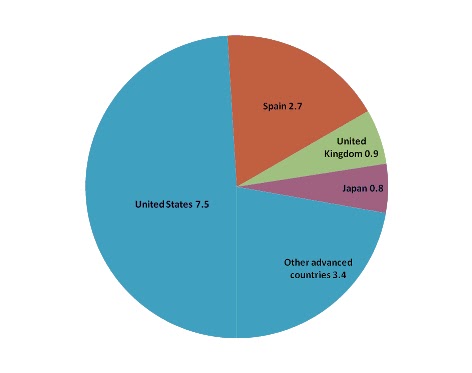
    Change in number of  unemployed people in advanced countries: 15.3 million  
    Source: IMF-ILO, 2010, Oslo
    Labour legislation has the double function of protecting workers against hazardous working conditions and abuse of market power as well as acting as an automatic stabilizer against the volatility and over-shooting of under-regulated labour markets. However, in recent decades there has been a regulatory race to the bottom. Deregulatory ‘successes’ in one country created parallel pressures to emulate it in neighbouring countries. True, not all countries deregulated to the same extent and some countries continued to pursue a high protection/high productivity path, but no country remained unaffected by the general tendency towards lower levels of protection. While a few individual countries managed to maintain and sometimes extend protective regulation under the current globalization regime, all felt the pressure to reduce labour costs by weakening employee rights and protection. This demonstrates the need for coordinated action to reverse the overall trend.
    During the three decades that prepared the grounds for the Great Recession, mainstream opinion in policy-making circles ignored or forgot what had been common sense 90 years ago when the ILO was founded.
    “The failure of any nation to adopt humane conditions of labour is an obstacle in the way of other nations which desire to improve the conditions in their own countries.(i)”
    Multinational companies and the global financial sector have undermined the capacity of democratic societies to ensure the sovereignty of the people and of law over the logic of the market. Profit seeking at the expense of the public good becomes an unavoidable reality when irresponsible business practices become legally possible. Sustainable enterprises based on the principles of collective bargaining, fair wages, non-discrimination, taxation and respect for labour standards are out-competed by those who do not hesitate to employ children, ignore minimum wages, evade taxation, circumvent labour legislation, save on health and safety and environmental protection, and abuse the open global economy to demand evermore preferable conditions for investment and externalize as many costs as possible to society.
    Universally applicable national labour legislation is necessary to avoid unfair competition within countries. It steers the economy towards a growth model based on innovation and product competition instead of exploitation. International Labour Standards complement and reinforce actions at national level. They are based on the understanding that in a global economy, national regulation must be harmonized and coordinated through an international labour standard setting process. They are safeguards against social dumping and can generate the mutual trust among nations that is a precondition for a stable open economy. Open markets can only be maintained when regulatory arbitrage is limited. If countries strive for export surplus by keeping wage growth systematically below productivity growth, they build up huge global imbalances and overcapacity that are not sustainable. Such strategies will either trigger a global race to the bottom or force other countries to adopt protective counter-measures.
    In order to avoid such a situation, governments need a mechanism that credibly ensures a regulatory floor applicable in all countries. This does not imply the establishment of absolute common standards, but it does involve a commitment towards a similar approach to labour protection in each country. Many labour standards do not entail substantial costs and can be applied in all countries independently of the level of development; such labour standards include the right to organize, the right to non-discrimination, the right to consultation with workers and employers, the right of workers to refuse work under hazardous conditions, the right to the safe handling of health-threatening chemicals and pesticides, and the right of workers’ organizations to access enterprises. Other standards, such as maternity protection, protection against excessive hours of work, and minimum annual vacation, are essential for workers’ health and should not be undercut under any circumstances. Moreover, many standards provide for flexibility in recognition of different levels of development. For example, coverage of a limited number of risks like unemployment, sickness, old age or invalidity for a certain percentage of the population is sufficient for ratification of the minimum social security convention.
    In 2009, ILO member states identified a set of labour standards for recovery as part of the Global Jobs Pact (GJP). They reiterated the importance of the core labour standards as human rights, but also recognised that for a regulatory response to the crisis, a much more comprehensive labour standards package was required.
    The standards identified in the GJP can be grouped into five areas:
    • Empowering workers to represent their interests by guaranteeing and promoting the right to organise and to bargain collectively as outlined in Conventions C. 87 and 98;

    • Protecting employees at the workplace against all forms of discrimination (C. 101) and abuse of force by employers (C. 29), against unjustified dismissal (Convention 158) and against the loss of wages in case of bankruptcy;

    • Guaranteeing minimum wage levels (C. 131) and social transfers that provide an adequate income floor (C. 102) and responsible public procurement policies (C.94);

    • Enforcing the application of labour laws and collective agreements for all workers through full recognition of the employment relationship and efficient labour inspections (C. 81);

    • Focusing all financial and economic policies on the objective of full, freely chosen and productive employment (C. 122).

    International Labour Standards are a potentially strong element to improve global governance and create the trust among nations that all countries apply labour standards – adapted to their level of development – in order to avoid a race to the bottom. This crisis must be the moment to strengthen governments’ commitments to labour standards as a contribution towards a globalization that respects workers’ rights and results in greater equality within countries and among nations. Universal ratification of existing ILO Standards would be a major contribution to coordinated global governance.
    The current ILO supervisory mechanism of regular reporting and independent assessment by a Committee of Experts is one of the most elaborate supervisory mechanisms in the United Nations (UN) system, but it has nevertheless not been strong enough to achieve the universal (or even close to universal) application of labour standards that member states expressed as desirable when they founded the ILO. Nearly all governments voted for the adoption of most conventions at international labour conferences. However, they have very often not followed up with ratification, let alone implementation.
    The previous decades of deregulatory irresponsibility have made a minority much richer and more powerful, but this regime did not serve that well societies at large. Continuing the drive for deregulation of labour markets will lead to a further rise in inequality, declining wage shares and unsustainable imbalances. If governments fail to provide credible international policy coordination including minimum labour standards, a re-nationalisation of economies will take place sooner or later. It might turn out as one of the ironies of history that those who continue to press for uncontrolled markets despite the bitter lessons of the Great Recession will be much more successful in destroying globalisation than the anti-globalisation campaigners of the last decades.
    Convincing governments and overcoming the resistance of market fundamentalists will crucially depend on the work of trade unions at both national and international levels. Trade unions have more influence in the ILO than in any other UN body, as they are part of its decision making structures. This is the time to campaign vigorously and to call on governments to consider a new ILO instrument with the sole objective of increasing the commitment to ratify and the capacity to implement existing labour standards. Moral persuasion and public exposure have proven to be insufficient incentives. The new mechanism should create a stronger pressure on governments to submit non-ratified conventions to their parliaments and to create financial obligations for all member states (except the least developed countries) that fail to do so or that fail to implement ratified conventions. These contributions should form a global fund for the promotion of international labour standards and help member states to create efficient and protected labour markets.
    A universal application of labour standards would be a major contribution to a well regulated global economy. Moral hazard and free riding are the enemies of all universal regulations. Whenever governments have been genuinely committed to mutual obligations, they have also been serious about enforcement. Demanding financial compensation from those who want to strive at the expenses of others is not a penalty or a sanction. It is necessary in order to level the playing field and to ensure that International Labour Standards do what they are supposed to do: decommodifying labour.

    Download this article as pdf

    Frank Hoffer is senior research officer at the Bureau for Workers' Activities of the ILO. He writes in his personal capacity.

    i Preamble ILO constitution (1919, Geneva)

    18 January 2011

    European Economic Governance: The next big Hold Up on Wages


    Ronald Janssen
    One of the main purposes of the current drive for European economic governance is to transform wages into the main or even single instrument of adjustment under monetary union. Strangely, this idea appears to enjoy a high degree of consensus among both conservative and progressive economists. For the former, extreme wage flexibility including wage cuts and sub-regional deflation is necessary if the rest of the Euro area is to catch up rapidly in competitiveness with Germany. For the latter, the rebalancing of competitive positions is to proceed by setting up some kind of ‘wage planification’ process at the European level in which German wages are to go up while wages outside Germany are going down and stay down for many years to come.
    Both views are based on the idea that there exists a direct and straightforward link between wages and competitiveness, as if one unit change in wage costs equals one unit change in competitiveness, or even jobs. However, a closer look at the German experience reveals that this assumption is totally flawed: competitive prices are not at the basis of Germany’s massive exports boom. What really drives German exports is the growth of its exports markets: if those economies into which Germany is exporting enjoy an economic boom, then German exports closely follow. Here, a recent analysis from the European Commission (2010) finds that the dynamism of Germany’s export markets explains almost the whole of the 7.3% annual average increase in its export volumes over the 1999-2008 period, whereas the contribution of more competitive pricing on German export performance is barely noticeable (0.3%).
    How to explain the fact that a decade of real wage stagnation has barely had any impact on Germany’s spectacular export boom? The reason has to do with the specialization pattern of its industry, focusing on products which the more dynamic (emerging) economies are most eager to buy (machinery, telecom equipment, transport infrastructures, etc.). This type of specialization pattern has the effect of making demand for German exports price inelastic: it is technical knowhow (‘how to produce efficient machinery’) and quality that count. In this equation, prices are a subordinated matter. Indeed, econometric studies (Artus, 2010) find that a 10% reduction in German export prices increases export volumes by 4% only. In the case of France, a similar price reduction would boost export volumes by as much as 12%.
    The fact that the demand for exports is relatively irresponsive to prices also explains why German business opted not to pass on falling unit labour costs in manufacturing into lower export prices. Doing so would only have made a small difference in export demand and overall production, implying a limited increase in total profits. The alternative of boosting profit margins by maintaining output prices while squeezing wages was substantially more attractive. In other words, business mostly used the sacrifices that were forced upon German workers during an entire decade to increase its own profit margins and dividend pay outs instead of creating jobs by becoming more competitive. In the end, it is not surprising to observe that the share of profits in Germany’s non financial sector has skyrocketed from 36.3% of gross added value in 2000 to 41.4% in 2008 (Eurostat, 2009).
    All of this implies that the ongoing discussion on European economic governance should be turned completely upside down. Pushing for competitive wage deflation in the Southern part of the Euro area is a dead end road. Given the deeply ingrained structural features of German industry, wage cuts in Spain or Portugal will barely alter these countries’ relative competitive positions with Germany. As argued above, the world is buying German exports not because they are cheap but because of their quality and of their type. By cutting wages, Southern Europe will mainly be competing for export demand with economies such as France, Eastern and Central Europe – or with themselves. However, the French economy, with high unemployment, is not exactly in the best position to digest the export shock that a wave of Southern wage deflation would bring about. Competing with Central and Eastern Europe on the basis of wages is also a lost cause: wages there are still much lower while most of these countries are outside the euro and may/will respond to a competitive wage devaluation by a competitive currency devaluation. This leaves workers in the South of Europe to compete…with each other. The ‘winner’ will be the country that cuts wages the most in comparison with the rest of the South. However, the taste of this ‘export’ victory will be bitter since the gain will come at the expense of a deep depression of domestic demand in the entire South of the Euro area.
    Unfortunately, the bad news does not end here. The mechanics of monetary union should not be forgotten either. With the economic weight of the South of Europe in the entire Euro area being limited to 15%, whereas the weight of Germany is as high as 25%, the response of monetary policy will necessarily be ambiguous. The European Central Bank is forced to set interest rates according to the average situation in the Euro area, not according to the situation in those parts of it that are in most trouble. This actually means that wage cuts in the South will be met with higher, not lower, interest rates as set by common Euro area monetary policy. With deflation taking hold while nominal interest rates are rising, the policy trap which these distressed economies find themselves in will be complete.
    In a cynical way, history is extracting its own revenge. When the single currency project was being set up back in the 1990s, rumours inside the Delors Commission claimed that monetary union would in the end cause so many problems that politicians would have no other choice than to take Europe forward. At that time, this referred to policies such as a substantially higher European budget, European investment policy and European taxes. Europe indeed now finds itself into such a situation calling for emergency action. However, blinded by the old obsession with cost competitiveness, it is cracking down on workers. This will prove to be a fatal mistake: extreme wage flexibility, even if it is presented as a type of ‘central wage planification’ in co-management with trade unions, in the end boils down to a big hold up on wages.

    Download this article as pdf

    Ronald Janssen works as an economic adviser in Brussels.

    References
    • Artus, P. (2010), Flash 2010, Paris 

    • Eurostat (2009), ‘Business profit share and investment are higher in the EU than in the USA’, Statistics in focus 28, Luxemburg.

    • European Commission (2010), ‘The impact of the global crisis on competitiveness and current account divergences in the euro area’, Quarterly report on the Euro Area, Vol. 9, No 1, Brussels

    17 December 2010

    Private Equity Investments and Labour: Current Trends and Challenges of Trade Unions


    Maria Alejandra Caporale Madi


    José Ricardo Barbosa Gonçalves

    The 2008 global economic crisis revealed how deeply the social life of the working class has been affected by deregulated finance. In this setting, the impact of private equity funds on working conditions has been attracting lots of attention since private equity funds - such as Blackstone, Carlyle Group or Texas Pacific Group - have been responsible for the employment standards of tens of millions of workers. Truly, as workers are confronted with over US $ 1-trillion in worldwide concentrated private equity buyout power, the relevance of private equity funds is outstanding in an analysis of the perspectives of mergers & acquisitions, employment and organised labour.
    The new employers and the rationalisation strategies
    This scenario has consolidated the work of new social actors: the fund managers of the private equity funds. Fund managers’ services include fund raising, financial statement analysis, company selection, restructuring implementation and ongoing monitoring of investments. Fund managers centralise endowments from investors, such as financial institutions, institutional investors - also pension funds - and high net worth individuals, among others, in order to assume key roles in acquisitions of high profit potential.
    In this financial and productive setup, capital has turned out to be faceless. In relation to the questions “Where does capital reproduction happen to be?”, “How does capital reproduce itself?” and “Who is benefiting from the capital reproduction process?”, the answers rely on the fund managers’ actions that attract the owners of capital to specific business. These investors have been attracted by fund managers who do not only promise high short-term profits but also offer the incentive of seductive “irresponsibility” toward the portfolio companies. The fund managers assume full responsibility over the business and, thus, they have autonomy to implement any kind of operational and financial restructuring strategy. The real target of the fund managers is to sell the companies within ten years after the acquisition.
    In fact, in the United States and many European countries, the behaviour of fund managers, entirely premised on profit targets aimed to increase short-term cash flow, have increased workers’ exploitation. Beyond the “rationalisation” strategies, social conflicts and tensions are strengthened as restructuring actions reshape the control on workers and increase staff turnover, outsourcing and casual work. Under the fund managers’ pressure, the portfolio companies turn out to be subordinated to narrow economic efficiency targets that shape employment relations for the worse. Workforce displacement and loss of rights are also part of the spectrum of management policies aimed at cost reduction. The challenges to the employment conditions that have been negotiated by trade unions through collective bargaining reveal the emergence of private equity funds as major “invisible” transnational employers. In fact, this “faceless capital” configures new employment relations and increases pressure on organised labour.
    Private equity short-term returns and exit strategies have increased the challenges on collective bargaining power because of the accelerated cost-cutting through layoffs, closures, outsourcing and further reductions in productive investment. In this setting, the Global Unions have reported that private equity firms, mainly buyouts, have been threatening employment, working conditions and workers’ rights through their financial strategies (IUF, 2007).
    Global Unions’ agenda
    Global Unions have been mobilising against the business model of the private equity funds that poses risks not only to the sustainability of productive investment and employment in domestic markets but also to the stability of the international financial system. This attempt has included joint efforts and activities with the International Union of Food, Agricultural, Hotel Restaurant, Catering, Tobacco and Allied Workers´ Association (IUF) and Union Network International (UNI), as well as cooperation with the Trade Union Advisory Committee (TUAC) and the International Trade Union Confederation (ITUC), and International Metalworkers’ Federation, among others.
    Global Unions have been defending the view that the re-regulation agenda could promote long-term productive investment growth, employment creation based on the decent work agenda, employment security and protection of trade unions’ rights (IUF, 2007). To achieve this, the following workers’ rights should be secured: collective bargaining, information, consultation and representation within the workplace; trade union representatives should be informed about the capitalisation and debt structure of the buyout deals and who the ultimate investors are; additional government protection for workers affected by private equity takeovers – this could follow from the recent steps taken to uphold the employer responsibilities of private equity firms (ITUC, 2007).
    In addition, Global Unions defend the view that regulatory reforms should address transparency to guarantee full access to audited financial accounts, particularly disclosing:
    • characteristics of debt contracts (total amount, types and maturities, rates and schedules):

    • restrictions on assuming more debt and the identity of the lenders/holders of the debt securities if they are not publicly traded:

    • analysis of earnings (debt to earnings ratios, dividends to earnings ratios; special dividends financed through additional debt, fees);

    • business plan guidelines (exit strategy, plans for selloffs/closures, management of cash flows, financial assets);

    • investments in plants, equipment and research;

    • labour conditions strategies (employment methods, training, pension funds/retirement benefits and negotiations with unions).

    Regulatory reforms should also enforce changes in tax regulation to cover private equity regimes so that tax systems are not biased toward short-term investor behaviour. The regulatory Global Union agenda also includes the revision of corporate governance frameworks to include unlisted companies. Such regulation could include the following: measures to discourage short-termism: greater transparency and public reporting requirements; more supervision by public authorities; limits to debt; changes in taxation of capital gains; and ensuring that private equity funds comply with all relevant employer obligations (ITUC, 2007).
    According to suggestions from the Global Unions, it is also important to address regulatory changes to enhance the stability of the international financial system. This proposal reveals a strong concern about the risks that private equity funds, mainly buyouts, pose to the sustainable growth of national economies in the global economy.
    Conclusion
    According to the ITUC (2007), “(o)nly government action can curb the external impact and the outright exploitation of these investment activities.” Current trends in investment and private equity indeed provide an important opportunity for discussion and reflection about the global articulation of workers and unions. This relates to trade union representation as well as to the challenges presented by the impact of the political and economic forces beyond the private equity business model that organisations face.

    Download this article as pdf

    José Ricardo Barbosa Gonçalves and Maria Alejandra Caporale Madi are both Professors at the Instituto de Economia, State University of Campinas (UNICAMP) as well as researchers with the Centre for Labour Economics and Trade Unionism (CESIT). José has been doing research about neoliberalism, trade unions and social exclusion, and Maria’s work focuses on financialization, corporate governance and social exclusion.

    References
    • International Trade Union Confederation [ITUC] (2007), Where the House Always Wins: Private Equity, Hedge Funds and the new Casino Capitalism, ITUC Report. Available online at:
      http://www.ituc-csi.org/IMG/pdf/ITUC_casino.EN.pdf

    • International Union of Food, Agricultural, Hotel, Restaurant, Catering, Tobacco and Allied Workers´ Association [IUF] (2007), A Workers´ Guide to Private Equity Buyouts, Geneva. Available online at:
      http://www.iufdocuments.org/www/documents/A%20Worker%27s%20Guide%20to%20Private%20Equity-e.pdf

    13 December 2010

    Maturing Contradictions: the 2010 Public Sector Strike in South Africa


    Claire Ceruti
    The huge strike in August by South African public sector workers brought the number of strike days in 2010 to the highest ever. Teachers and hospital staff struck for three weeks despite police harassment of picket lines and a series of court interdicts to prevent police, soldiers and nurses from striking(1). The strike started after members forced their leaders to reject government’s ‘final offer’ of 7% and R700 (€70) housing allowance. After seeing the government’s lavish expenditure on the 2010 soccer world cup, strikers found it difficult to believe that government could not meet their demands. The public servants were asking for an 8.5% wage increase and R1000 (€100) a month housing subsidy. However, the strike was much more than a wage strike: three years ago, public sector workers struck during the dying days of the regime of previous president, Thabo Mbeki, while the 2010 strike was a major test of his successor, Jacob Zuma and thus of the unions’ strategy for social change.
    The political implications of the strike were reflected in a striker’s placard: ‘Comrades are like buttocks. When they part 7% (shit) comes out.’ This is a direct reference to the alliance between the ruling African National Congress (ANC), the South African Communist Party (SACP), and the biggest trade union federation, Congress of South African Trade Unions (Cosatu), whose affiliates comprise a majority in the public sector. Cosatu’s strategy for change since the end of apartheid has been to influence government policy through this alliance. The strategy foundered under Mbeki, who was the architect of a home-grown neo-liberal program for South Africa before he was president. Under Mbeki, corporate tax was cut, more than a million jobs were lost and homelessness grew quicker than provision of low-cost government housing, leaving 15% of the country’s population living in self-built iron shacks today.
    The revolt against Mbeki was a long time maturing. It finally exploded on several fronts. From 2005, some of the poorest townships in South Africa took to the streets before municipal elections. The service delivery protests demanded not only the ‘better life’ promised in ANC election campaigns but also more accountable government. There was also a revival of wage strikes. These developed in tandem with a revolt inside the ANC and crisis in Cosatu’s strategy. Union leaders were increasingly embarrassed that Mbeki used the alliance to assert his authority over the unions, while dismissing their policy suggestions. Rather than concluding that Cosatu should become more independent, its leaders looked for friendlier faces within the alliance. A variety of forces, including Cosatu’s general secretary Zwelinzima Vavi, sided with Zuma after Mbeki expelled him from the cabinet. Zuma did not take the strikers’ side in 2007, but argued for both parties to return to negotiations. However, the December 2007 conference of the ANC (now simply known as ‘Polokwane’ after its location), which voted for Zuma as ANC president, also promised better conditions for public sector workers.
    The 2010 strike unfolded against the post-Polokwane reconstitution of the alliance, and exposed some of the contradictions between members’ interests and the broad strategy of the union leaders. The 2007 strike was initiated by union leaders kicking against their marginalization in the alliance, and enthusiastically supported by the members. The 2010 strike, by contrast, was forced on reluctant leaders by the righteous expectations of the members.
    On the one hand, union negotiators were confident that their new comrades in government, beholden to the unions for helping them to power, would make a satisfactory offer. On the other, government negotiators hoped their comrades in the unions would sell a deal to the members. They were under pressure to rein in wage demands both because of the fiscal hangover from the world cup and also to reassert authority amidst the new confidence of various alliance members to critique ‘their’ government publically. However, members were expecting nothing less from Zuma than to meet their demands. Any early misconceptions that government negotiators were acting against Zuma’s real intentions and against ANC policy were quickly dashed when Zuma appeared on national television, just days into the strike, asserting the government’s right to dismiss ‘essential workers’ who continued to strike.
    Government came down hard on the strikers. Police used rubber bullets and water cannon on pickets at several hospitals on the second day of the strike, and fired on teachers who walked onto a highway near Soweto. The mainstream media conducted a vitriolic campaign, blaming strikers for deaths of babies and disrupting education. Months before, six babies had died in a hospital under ‘normal’ conditions because of a shortage of basic disinfectants. Two months earlier, schooling was suspended for the world cup, while in Nelspruit learners are still without a school after their high school was converted into stadium offices. Without a strike support committee bringing affected communities into direct contact with the strikers, this moralistic pressure proved key in isolating strikers as the strike dragged on.
    However political considerations were also important to understand why the strike was concluded as it was on September 6 with an agreement that most strikers feel was imposed from above. Cosatu was about to announce its proposals for economic policy, ahead of the ANC’s national general council and therefore could not afford an all out defeat of the strike but neither could they afford to reach a breaking point with Zuma’s camp if they wanted their policies to get a hearing. On August 27 a government spokesperson, Themba Maseko, was quoted in the Business Day newspaper saying: ‘We are beginning to see and hear too many statements that are taking the strike beyond labour relations. It worries us’..
    Vavi therefore played a very contradictory role throughout the strike. His role followed the logic of collective bargaining with a political edge: a negotiator influenced by strategic considerations related to the alliance. At a march in Johannesburg 12 days into the strike, on 26 August, Vavi echoed strikers’ anger, declaring that ‘the alliance is once again dysfunctional’. He also lambasted ‘predatory elites’ in the ANC and – crucial to the strikers’ confidence – announced that the federation had filed notice for a one day general strike in solidarity with the public workers. However behind the scenes, he was working hard first to avert a strike and then to settle the strike. Vavi describes this role in a remarkably unselfconscious letter after the strike, responding to the teachers’ union’s accusations that they had been sold out. The letter encapsulates the contortions of a union leader caught between his comrades in government and the fledgling force pushing up below. Vavi writes that the negotiators were ‘acutely aware how difficult it was for government to move’ and describes a number of attempts to reach a compromise on figures suggested by the public sector union officials, but apparently not caucused with their members.
    Shortly after the 26 August march, Zuma ordered the parties back to negotiations. Many strikers took this as a signal that they were wining. The announcement of the new offer – 7.5 percent – was a major blow to their morale. Most were also furious that Vavi announced this deal on national radio before it was put to the members, urging strikers to accept it because it was ‘impossible’ to win anything more. Vavi’s reading is that government negotiators felt betrayed by their union comrades who had twice promised they could sell a deal to members, only to be told the members had rejected it.
    Despite Vavi’s recommendation, most hospitals and most regions of the Cosatu teachers’ union rejected the offer, often unanimously. However after three weeks of no-work-no-pay, combined with worries about patients and learners, and demoralized, shrinking picket lines, the strikers lacked inspiration to continue the strike. After some days of uncertainty the strike was ‘suspended’.
    The political residues of the strike have not washed away easily, however. The Zuma regime is nervous about the ability of its alliance partner to control its members. They took it as a full frontal attack when Cosatu called a ‘civil society conference’ to which the ANC was not invited. Government’s New Growth Path makes many promises to Cosatu and few concessions to its economic suggestions, while making a social pact – a new means of binding the unions - central. Less visible, but no less important, is the political residue in the minds of strikers. It is firstly evident that strikers have begun to generalize beyond their own sectoral issues. Strikers in 2010 sympathised with service delivery protests much more readily than in 2007. Secondly, strikers learned a hard lesson in the logic of the alliance and of collective bargaining. At least one striker felt that the strike became a lever for Vavi’s own political ambitions. Finally, strikers in 2010 moved quickly to directly criticizing Zuma. The strike demonstrated that the contradictions are likely to unfold much more quickly for Zuma than for Mbeki.
    (1) Government and the unions have failed to reach agreement on who is an essential worker.

    Download this article as pdf

    Claire Ceruti is a researcher attached to the South African Research Chair in Social Change at the University of Johannesburg. She has been doing research about class and strikes.

    6 December 2010

    The struggle against pension reform in France


    Philippe Légé
    In 2010, France has experienced an intense social struggle. The triggering factor was the pension reform which the government of Prime Minister François Fillon argued was necessary to “save the pension system”. The French system relies on compulsory basic and supplementary state pension schemes financed mainly by contributions (proportional to wages) and taxes decided at national level. According to the government, because of the growing number of retired people and an ageing population, it is necessary to raise the legal retirement age from 60 to 62 (and from 65 to 67 for a full pension) in order to encourage people to work longer. But the trade unions are very sceptical about this reasoning, for the average age at which workers cease activity is 58.8 years. And 60% of workers are not in employment when they claim their pension rights: they are either unemployed, or invalid. For example, “25% of nurses and 40% of auxiliary nurses are invalid when they retire” (Lambert 2010). In the first part of this article, the terms of the debate will be analysed, and in the second part the struggle around the pension reform will be discussed.
    Unconvincing official arguments for pension reform
    “It is demographic, not political. If you live longer, then you must work longer”. The previous French governments used similar arguments in support of the pension reforms that took place in 1995, 2003 and 2007. The ratio between the number of retired people and the number of contributors is undoubtedly increasing – but by how much? It is now clear that previous official reports exaggerated the demographic trends. The birth rate did not fall and the economically active population will not decline. The latter will actually increase until 2015, and then remain constant unless policies are adopted to increase women’s employment. The evolution of the active population is a political issue: it is limited to a demographic issue only when the government has no employment policy!
    There are only two possible adjustment policies when a population is getting older: either to reduce the pension per capita or to increase the share of national wealth dedicated to pensions (which currently stands at 13% of GDP in France). Workers understood that, despite official propaganda, the proposed reform did not favour the latter solution. Because of uneven and incomplete careers, as a result of unemployment and increasingly casual jobs, the only outcome of the reform will be a decrease in pensions. Indeed, the effects of similar reforms proved to be regressive: according to the French Conseil d'Orientation des Retraites (Pensions Advisory Council), the pension represented on average 79% of a person’s pre-pension wage in 1995, but the ratio fell to 72% in 2007 and is expected to be 65% in 2020. The effects of the 2003 Fillon reform provide strong arguments against the 2010 Fillon reform.
    The evolution of the pension system is the result of a complex set of factors, which the government gets deliberately mixed up. In 2007, the French pension system was running a slight surplus; in 2008, it had a deficit of €6.9 billion which has increased to €32 billion in 2010 (11 billion for basic pensions and 21 billion for supplementary pensions). Yet, only 10% of this deficit is linked to the rising number of retired people. The main cause of the current deficit is the economic crisis. The GDP share of spending for pensions is stable but income is decreasing because of unemployment and sluggish growth. Well, who is responsible for the crisis, one could ask? Having bailed out the banks, the government is now asking workers to make an effort. Yet, it would be possible to finance the deficit by raising the contributions paid by employers. Of course, capital owners will argue against “increasing the costs of labour”, a move which is assumed to endanger the competitiveness of companies that will then have no choice but to lay off workers or relocate. But in actual fact, any subsequent problem of competitiveness could be solved by decreasing dividends. In 1980, dividends were equivalent to 4.2% of total payroll, a ratio which rose to 12.9% in 2008. Hence, the only problem with pensions is a distribution problem – and the ‘competitiveness’ argument is simply misleading (Husson, 2003).
    Pensions at the root of a broader social movement
    Two associations (Copernic Foundation and Attac, 2010) made a strong case against the reform, developed alternative analyses and gathered social and political forces on the left. During spring, they organized debates all over the country. Then, the demonstrations called by all trade unions were a real and surprising success: 1 million people were on the streets on the 27th of May and 2 millions on the 24th of June. After the summer break, the movement grew even stronger. Truck drivers, teachers, port and rail workers, students and a very large number of private sector workers went on strike and united in a large movement against the government. They participated in huge demonstrations (gathering 3.5 millions on the 12th of October), blocked some freeways and organized general meetings. Because of the strike, ten of the twelve national oil refineries shut down and many petrol stations were empty for two weeks. The movement nevertheless remained popular, being approved by nearly 80 percent of the population. Its strength forced the unions to remain united against the government. It prevented the CFDT (the less pugnacious of the two largest French unions) from withdrawing from the movement.
    How can one account for such a large and popular movement? The evolution of the pension system is a matter of civilization, and pension reform was not the only source of revolt. Unemployment and deteriorated working conditions also featured prominently in the general meetings. In the debate concerning the conditions under which workers employed in difficult or hazardous jobs can retire earlier, the government wrote that "wage-earners must be physically worn-down when retiring" (see: http://www.retraites2010.fr/le-projet-de-loi/mettre-en-place-un-dispositif-de-prevention-et-de-compensation-de-la-penibilite). But what could be more justified than workers benefiting from retirement before they are ill or exhausted? Moreover, for the vast majority of French people, the government had lost much of its legitimacy. In September, when Eric Woerth, the minister in charge of the pension reform, said that the text "could not be changed", anyone knew that he had been much more understanding with wealthy people when he was formerly budget minister. During the summer, the Woerth-Bettencourt scandal had exposed the close relationships between political and economic powers. With a fortune estimated at $20 billion, Liliane Bettencourt, the main shareholder of L'Oréal, is one of the wealthiest people in the world. In June, tape recordings revealed that she had dodged taxes by using undeclared Swiss bank accounts and that Woerth’s wife had been given a job managing Bettencourt’s wealth. Mrs Bettencourt received a €30 million tax rebate while Mr. Woerth was budget minister. Moreover, Bettencourt’s former accountant has claimed that conservative French politicians were frequently given envelopes stuffed with cash to finance their campaigns (see: http://www.guardian.co.uk/world/2010/jul/12/nicolas-sarkozy-bettencourt-scandal).
    Further evidence of the relationship between political and economic powers appeared in articles concerning the French President's brother, Guillaume Sarkozy. He is not only a textile entrepreneur and the vice-president of the French employers’ association, but also the general manager of Malakoff Médéric. This mutual insurance company created in 2010 a private subsidiary company (Sevriena) in order to take advantage of the pension reform. While Nicolas reduces state pensions, Guillaume sells supplementary private pension schemes. Nicolas Sarkozy is widely perceived as “the President of the very wealthy” because he created the famous “tax shield”, providing a protection against taxes on high incomes.
    Conclusion
    The French social movement of the fall of 2010, particularly the strike by oil workers, has shown the great power and determination of the working class. But the government defeated it by conscripting energy workers and ordering the riot police to disperse picket lines, before promulgating the reform. The outcome of the struggle has been influenced by three elements. Firstly, the economic impact of the movement has been weakened by a reactionary law of 2007 forcing rail workers to give an individual 48 hour notice of strike actions. But the government went much further by conscripting some workers of the private sector. The unions initiated a procedure against this illegal restriction of strikes, which is currently proceeding. Secondly, the fragility of the movement itself was partly due to the crisis and the unemployment which had placed the workers in a difficult position. Finally, Sarkozy was putting his political future in the balance with this reform. Hence, the challenge was a very difficult one: any victory was impossible without bringing Sarkozy and the government down. However, the movement allowed many people to make interesting democratic mobilisation experiences and all reached the same conclusion: a battle has been lost but the war is not over.

    Download this article as pdf

    Philippe Légé is Assistant Professor of Economics at the University of Picardie (UPJV, France). His work is in the history of economic thought and the analysis of the current crisis. He's a member of the French Association of Political Economy (AFEP).

    References

    Attac and Fondation Copernic (2010), Retraites, l'heure de vérité, Paris: Sylepse.
    Husson, M. (2003), “Exploding the Myth of Competitiveness”, Le Grain de Sable, N° 430, available at: http://hussonet.free.fr/competns.pdf
    Lambert, R. (2010), “Non, c'est la cheville”, Le Monde diplomatique, November. Available in French at: http://www.monde-diplomatique.fr/2010/11/LAMBERT/19841
    Pensions Advisory Council Reports (2010), Huitième rapport du Conseil d'orientation des retraites, 14 April, available in French at: http://www.cor-retraites.fr/rubrique3.html

    Newer Posts Older Posts Home

    Share

    Twitter Facebook Stumbleupon Favorites More

    Subscribe to the Mailing List

    If you want to subscribe to the GLC mailing list, please click here or send an email to "sympa@ilo.org" with subject "sub list-glcolumn".

    Contribute to the GLC

    If you want to contribute to the Global Labour Column, please read here the Guidelines for Contributions

    Languages


    Donations

    More Info

    Popular Posts

      From Financial Crisis to Stagnation: The Destruction of Shared Prosperity and the Role of Economics
      Trade Unions, Class Struggle and Development
      Supporting Dissent versus Being Dissent

    TAGS

    Financial Crisis Trade Unions Neoliberalism Globalisation Labour Market Development Strategies Wage Decent Work Growth Social Movements Workers' rights Collective Bargaining Financial Market Labour Standards Financial Regulation Inequality Social Security Tax Europe Fiscal Space Public Investment Social Democracy Corporate Governance Economic Democracy Struggle Competitiveness Environment Global Warming Informal Economy Care Work Central Bank Domestic Workers Progressive alliances Business and Human Rights Capital Flight Economic Development Online Campaigning Pensions Public Works Programmes

    PUBLICATIONS

    Click here to view more

    Blog Archive

    • ▼  2012 (12)
      • ▼  May (1)
        • From Financial Crisis to Stagnation: The Destructi...
      • ►  April (2)
      • ►  March (3)
      • ►  February (4)
      • ►  January (2)
    • ►  2011 (39)
      • ►  December (3)
      • ►  November (4)
      • ►  October (3)
      • ►  September (4)
      • ►  August (3)
      • ►  July (2)
      • ►  June (3)
      • ►  May (3)
      • ►  April (4)
      • ►  March (4)
      • ►  February (4)
      • ►  January (2)
    • ►  2010 (39)
      • ►  December (3)
      • ►  November (5)
      • ►  October (4)
      • ►  September (2)
      • ►  August (2)
      • ►  July (3)
      • ►  June (4)
      • ►  May (1)
      • ►  April (4)
      • ►  March (4)
      • ►  February (4)
      • ►  January (3)
    • ►  2009 (5)
      • ►  December (3)
      • ►  November (2)

    Popular Posts

      From Financial Crisis to Stagnation: The Destruction of Shared Prosperity and the Role of Economics
      Trade Unions, Class Struggle and Development
      Supporting Dissent versus Being Dissent

     
    Copyright © 2011 GLCtest | Powered by Blogger
    Design by Free WordPress Themes | Bloggerized by Lasantha - Premium Blogger Themes | 100 WP Themes